Unit I
IN THIS LESSON
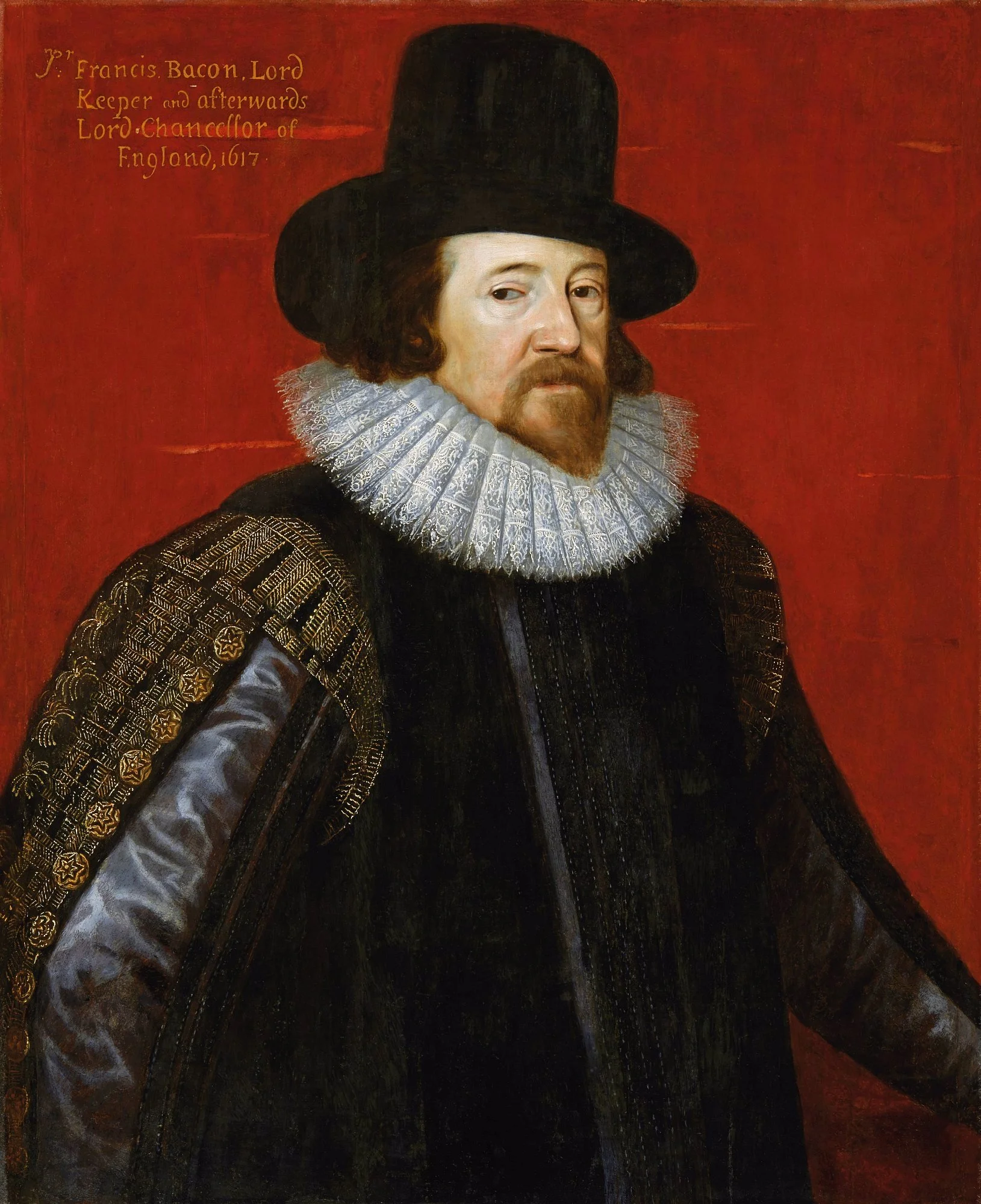
Francis Bacon’s revolution wasn’t about solving the old puzzles of knowledge, but about changing the very rules of inquiry — turning epistemology outward, toward the world.
Topics discussed:
The Aristotelian worldview once made the world feel intelligible, but its central pieces began to collapse under new observations and conceptual pressures.
Around 1600, linguistic, technological, and cultural shifts gave rise to a new meaning of “experiment”: not trying something, but deliberately manipulating nature to reveal hidden causes.
Early experimentalists were seen as eccentric outliers whose strange new practices challenged tradition and authority.
Francis Bacon argued that knowledge begins with experience, requires purging our “idols,” and aims at prediction, control, and the relief of human suffering.
Bacon introduced ideas that anticipate empiricism, pragmatism, and positivism—each redefining what it means to know and what counts as meaningful inquiry.
Though powerful, Bacon’s model faces the challenge that predictive and explanatory success can still come from false theories (e.g., Ptolemy, alchemy).
The lesson closes by placing Bacon’s “knowledge is power” view beside Plato’s JTB theory, raising the question: What is knowledge, really?

Focus Questions
What is a worldview?
How might we argue that the Aristotelian worldview, with its geocentric framing of the cosmos, wasn’t merely superstition but a coherent system backed by the available data?
How did the rise of controlled experimentation change what philosophers and scientists meant by “knowing” something?
What does Bacon think prevents us from seeing the world clearly, and how do his “idols” relate to modern ideas about cognitive bias?
Why does Bacon mean when he argues that knowledge is fundamentally connected to power, prediction, and control?
Define the following: empiricism, pragmatism, positivism.
What is a potential objection to Bacon’s views on knowledge? If successful theories can still be false (like Ptolemy’s), does Bacon’s method guarantee knowledge exactly—or only usefulness?
Does Bacon’s approach offer a genuine escape from the regress argument, or does it simply shift the questions we ask about justification?

Glossary
The Modern Worldview Shift: From Aristotle to Bacon
Worldview: A grand puzzle or coherent system that makes the world feel intelligible by quietly teaching what to trust and how to reason.
Aristotelian Worldview: An ancient cosmological and physical model centered on the Earth, where motion was explained by the intrinsic natures of the five elements.
Modern Experiment: A conceptual shift where an experiment became a concerted, artificial manipulation, often using special instruments, designed to probe hidden causes.
Francis Bacon and the New Method
Francis Bacon: A philosopher and statesman credited with developing the scientific method, who advocated for replacing certainty with progress and authority with collective inquiry.
Idols of Bacon: Four categories of human bias (Tribe, Cave, Marketplace, and Theater) that Bacon warned must be purged from the mind for true inquiry.
Knowledge-as-Power: Bacon’s claim that to truly know something is to be able to predict it, control it, or successfully make it.
New Philosophical Traditions
Empiricism: The view that knowledge is fundamentally rooted in experience and observation, rather than in inherited doctrine or pure reason.
Pragmatism: The view that abstract concepts like truth and value should be evaluated based on how useful they are as tools for thinking.
Positivism: A philosophical tradition that states only empirically verifiable statements have meaning and distrusts speculative philosophy.
Francis Bacon’s “Idols” and Their Modern Analogues
Bacon argued that human beings are prone to systematic errors in thinking that distort how we understand the world. Many of these “Idols” look strikingly similar to what cognitive scientists now call biases.
| Idol | Bacon’s Definition | Source of the Error | Modern Cognitive Bias Analogue | Contemporary Example | Corrective Practice |
|---|---|---|---|---|---|
| Idols of the Tribe | Errors that arise from human nature itself—our tendency to see patterns, impose order, and interpret the world in ways that flatter our expectations. | Built-in features of human cognition | Patternicity, Confirmation Bias, Availability Heuristic | Seeing “trends” in random stock fluctuations, reading deep meaning into coincidences, or assuming a few vivid examples reflect reality as a whole. |
Ask: “Am I detecting a genuine pattern, or imposing one?” Use base rates, larger samples, and statistical reasoning. |
| Idols of the Cave | Errors that arise from individual perspective—our upbringing, temperament, education, and personal experiences shape a private “cave” through which we interpret reality. | Personal history and subjective perspective | Motivated Reasoning, Confirmation Bias, Identity-Protective Cognition | Rejecting evidence because it conflicts with your political identity, family values, or preferred worldview. |
Ask: “What evidence would actually change my mind?” Deliberately seek out the strongest opposing view. |
| Idols of the Marketplace | Errors caused by language and communication—words are often vague, emotionally charged, or misleading, and they can distort thought. | Social use of language; ambiguity in words | Framing Effect, Semantic Confusion, Labeling Bias | Two people arguing about “freedom,” “justice,” or “science” while using the same words in very different ways. |
Ask: “What exactly do we mean by this term?” Define terms before debating conclusions. |
| Idols of the Theater | Errors arising from systems, doctrines, and dogmas that people accept uncritically—like an audience watching an impressive but misleading play. | Authority, tradition, ideology, and inherited theories | Authority Bias, Belief Perseverance, Theory-Ladenness | Accepting a philosophical, political, or scientific framework just because it is prestigious, familiar, or institutionally dominant. |
Ask: “What assumptions does this whole framework depend on?” Evaluate systems critically rather than reverently. |
Big picture: Bacon’s “Idols” are recurring distortions in human thinking. In modern terms, they are systematic cognitive errors that can block careful inquiry.
For other questions…

Reading List
Julia Annas, The Morality of Happiness.
Francis Bacon, Novum Organum.
Francis Bacon, The Advancement of Learning.
Lorraine Daston & Elizabeth Lunbeck, Histories of Scientific Observation.
Richard DeWitt, Worldviews: An Introduction to the History and Philosophy of Science.
Joseph Henrich, The WEIRDest People in the World: How the West Became Psychologically Peculiar and Particularly Prosperous.
Louis Menand, The Metaphysical Club : A Story of Ideas in America.
Karl Sigmund, Exact Thinking in Demented Times: The Vienna Circle and the Epic Quest for the Foundations of Science.
Phil Washburn, Philosophical Dilemmas: A Pro and Con Introduction to the Major Questions and Philosophers.
David Wootton, Bad Medicine: Doctors Doing Harm Since Hippocrates.