Unit I
IN THIS LESSON
Locke promises a “blank slate” mind—but once you follow the logic, his empiricism starts sliding toward skepticism.
Topics discussed:
Three “contenders” for what knowledge is:
Descartes (JTB + foundationalism)
Bacon (knowledge as power)
Locke (empiricism)
Locke’s tabula rasa (blank slate) and why he rejects innate ideas
How Locke tries to calm intellectual arrogance: learn the limits of the human mind
Objections to Locke: Berkeley’s skeptical pressure, Hume’s problem of induction, and modern cognitive-science pushback on the blank slate
How each theory hits a wall (utility vs certainty vs “reliable enough”)
Pyrrhonian skepticism as a therapy for overconfidence in theory


Focus Questions
What does Locke mean by the mind as a “blank slate,” and what is he trying to accomplish with that claim?
Why does Locke think mapping the limits of understanding could make people more tolerant and less dogmatic?
How does Locke’s “outside → in” approach differ from Descartes’ “inside → out” method of doubt and foundations?
What is Locke’s attitude toward the infinite regress problem—and why does he basically refuse to treat “infinity” like something we can experience?
Why does Berkeley think Locke-style empiricism is vulnerable to skeptical objections?
What is Hume’s problem of induction, and why does it look like the justification for induction is “more induction”?
Why do some contemporary scholars think the blank slate hypothesis is empirically false?
If perception tracks “fitness” rather than “truth”, what happens to Locke’s confidence that the senses resemble reality?
How do Bacon, Descartes, and Locke each hit a “wall”?

Glossary
Theories of Knowledge
Empiricism
The view that knowledge (or the materials of knowledge) comes primarily from sensory experience and reflection on it.Foundationalism
The idea that knowledge rests on a set of basic beliefs that do not require further justification (e.g., Descartes’ project).Proto-pragmatism (Bacon)
An approach that treats knowledge as tied to usefulness—prediction, control, and practical success—rather than certainty.Pyrrhonian skepticism
A therapeutic form of skepticism that suspends judgment about ultimate reality while continuing everyday practices, aiming at tranquility rather than theory.
The Mind and Its Contents
Tabula rasa (blank slate)
Locke’s claim that the mind begins without innate ideas and is gradually furnished by experience.Innate ideas
Ideas that are supposedly present in the mind prior to experience (affirmed by Descartes, denied by Locke).Reflection (Locke)
The mind’s awareness of its own operations—thinking, doubting, comparing—which serves as a source of ideas alongside sensation.
Perception and Representation
Indirect realism
The view that we do not perceive external objects directly, but only through mental representations or ideas.Skepticism
The philosophical pressure (or position) that we lack knowledge in some domain, often because justification cannot be completed.
Justification and Regress
Infinite regress problem
The problem that arises when every justification requires another justification, threatening an endless chain with no foundation.Circular reasoning
A defective form of justification in which a claim is supported by premises that already assume its truth.
Inductive Reasoning
Induction
Reasoning from observed cases to unobserved ones—for example, expecting future events to resemble past patterns.Problem of induction
Hume’s challenge that past experience cannot logically justify expectations about the future, making inductive reasoning philosophically fragile.
For other questions…


I mentioned in the lesson that a few philosophers from the era identified as Pyrrhonians.
Hume was one thinker I mentioned, although I should say that scholars speculate that he might’ve been a Pyrrhonian—although the jury is out.
One philosopher that was definitely a Pyrrhonian was Michel de Montaigne. Here’s an excellent video on Montaigne’s Pyrrhonism.
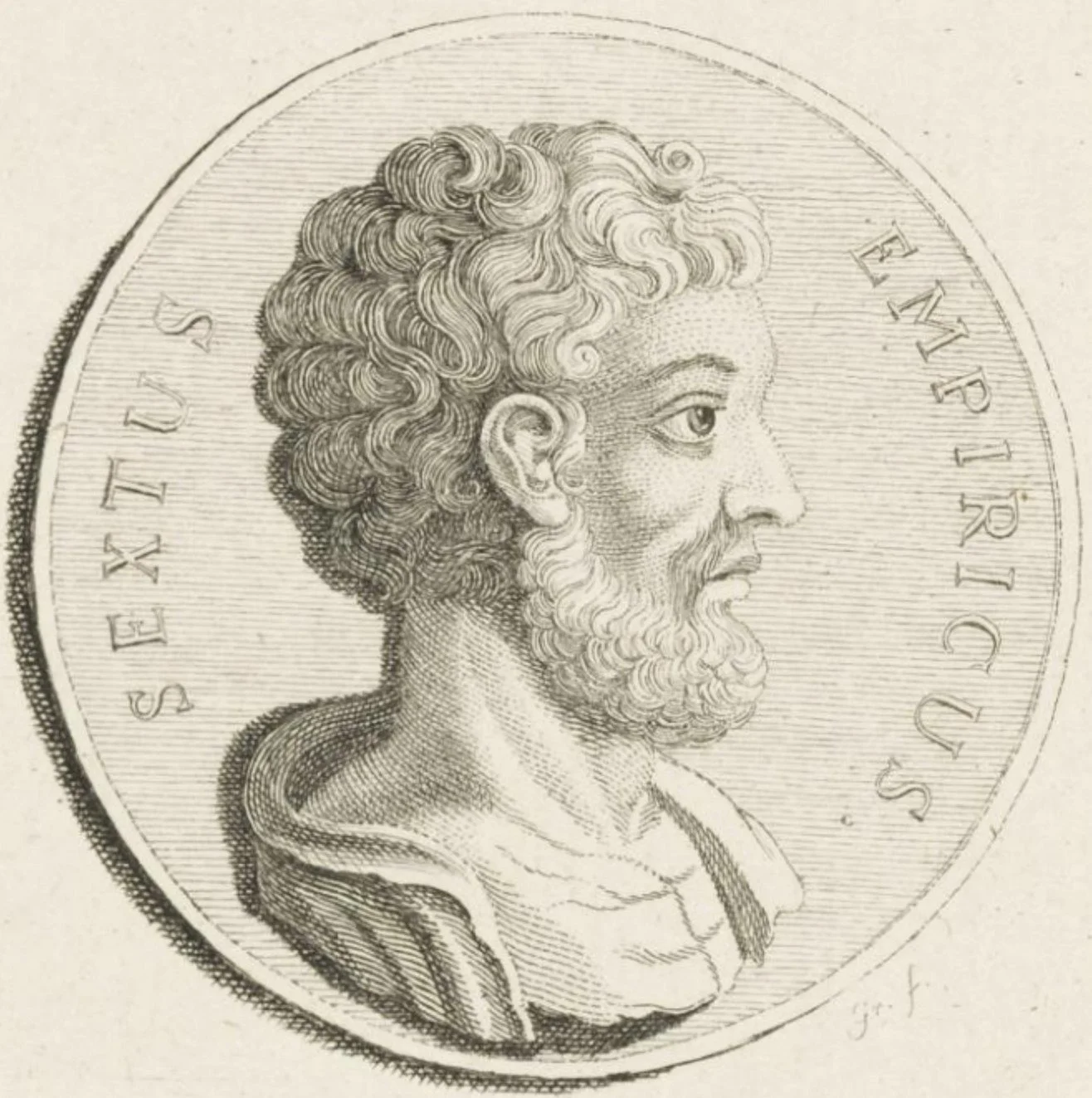
Another thing I can mention here is the difference between the Pyrrhonians and Francis Bacon’s results-driven approach to science. It is true that various Pyrrhonians from the ancient world, such as Sextus Empiricus, were results-oriented physicians; in other words, they wanted to heal their patients without obsessing over discovering the “true causes” of an illness. Put bluntly, they wanted results and rejected the quest for theoretical knowledge of disease.
This might sound a bit like Francis Bacon’s proto-pragmatic approach. However, Bacon was a bit more ambitious than the Pyrrhonians. Bacon would discuss wanting not only to alleviate pain by to extend human life. This might require some theoretical knowledge. The difference, then, is that Bacon did think some kind of theoretical knowledge was possible—through careful examination of nature. What sets Bacon apart from someone like Descartes is that Bacon believe that this knowledge was inductive and provisional. That is, we would never get 100% certainty in our theoretical knowledge, and we would should always be open to improving our theories with new experiments, new methods, and new discoveries.

Reading List
Francis Bacon, Novum Organum.
George Berkeley, A Treatise Concerning the Principles of Human Knowledge.
Richard Bett, How to Be a Pyrrhonist: The Practice and Significance of Pyrrhonian Skepticism.
Stanislas Dehaene, How We Learn: Why Brains Learn Better Than Any Machine… For Now.
Richard DeWitt, Worldviews: An Introduction to the History and Philosophy of Science.
Donald Hoffman, The Case Against Reality: Why Evolution Hid the Truth From Our Eyes.
David Hume, A Treatise on Human Nature.
Richard Joyce, The Evolution of Morality.
John Locke, An Essay Concerning Human Understanding.
Steven Pinker, The Blank Slate.
Ritchie Robertson, The Enlightenment: The Pursuit of Happiness, 1680-1790.