Unit II
IN THIS LESSON
When the world looks cruel, every defense of God becomes a theory of human nature.
Topics Discussed
The problem of evil argument and the two main ways to resist it: reject premise 1 or reject premise 2.
Leibniz’s “best of all possible worlds” theodicy, including its psychological promise of consolation and its ethical demand for active striving.
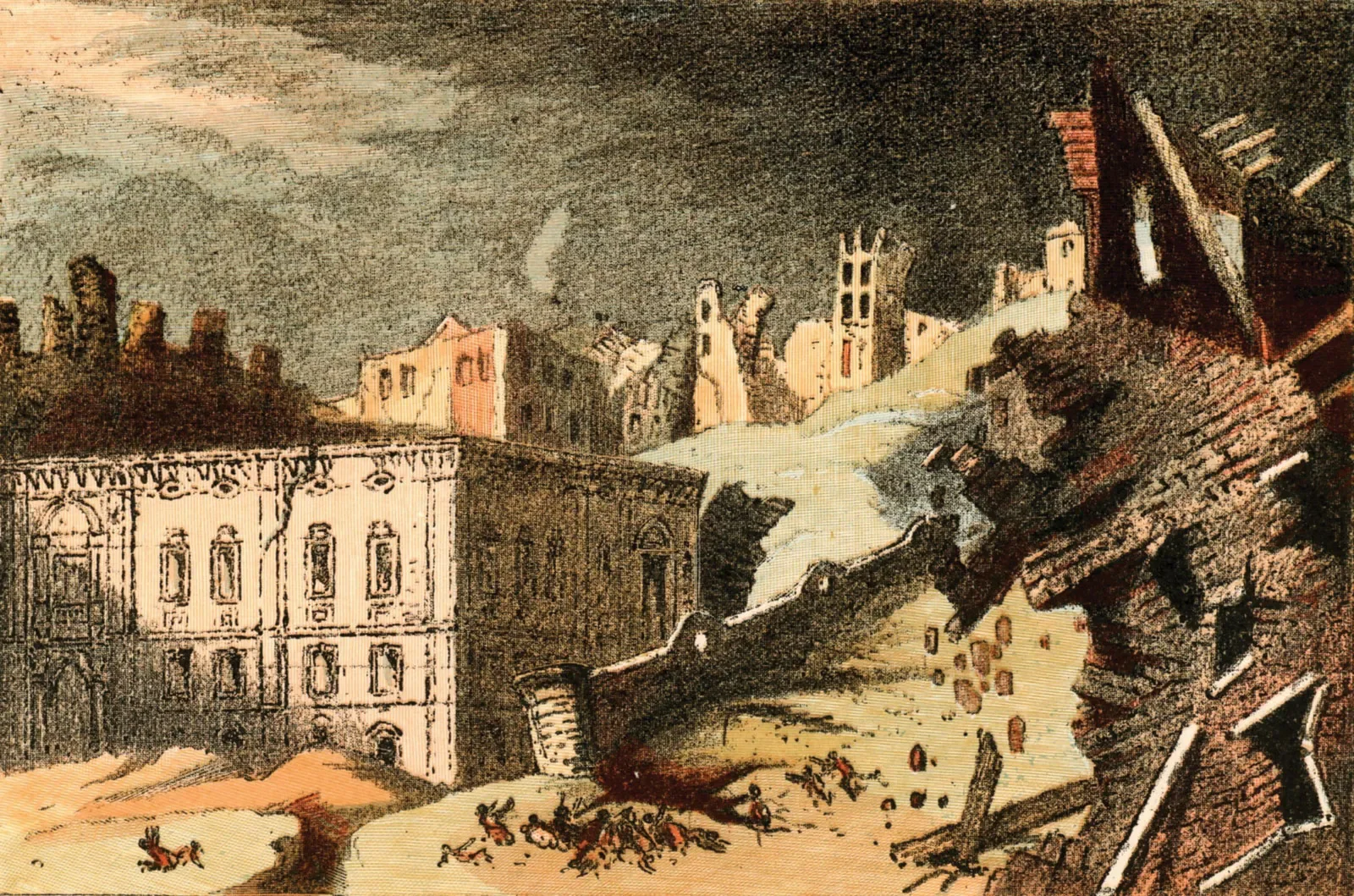
Voltaire’s mockery of Leibniz after the Lisbon earthquake, especially the charge that “the best of all possible worlds” sounds absurd in the face of real suffering.
Other responses to the problem of evil: deism, the devil, free will, evil as a counterpart to good, the soul-making defense, and skepticism about whether we can prove that unnecessary suffering exists.
The connection between theology and moral psychology in Hobbes, Leibniz, and Spinoza: whether people need religion, political authority, or freedom from superstition in order to live well.

Focus Questions
What is the problem of evil argument, and why does the argument seem valid if we accept both of its premises?
How does Leibniz’s theodicy respond to the problem of evil? What does Leibniz mean when he says this is the “best of all possible worlds,” and how does his musical analogy of dissonant notes help explain his view?
Why does Voltaire reject Leibniz’s optimism, and how does the Lisbon earthquake make Leibniz’s view seem morally or emotionally implausible?
How does deism respond to the problem of evil by changing the definition of God, and why might this concede too much to the atheist?
Why doesn’t blaming the devil fully solve the problem of evil, especially if God is supposed to be all-powerful and all-loving?
How does the free will response explain human-caused suffering, and why does it struggle with natural or non-anthropogenic suffering?
What does it mean to say that evil is a necessary counterpart to good, and why might this conflict with God’s omnipotence?
How does the soul-making defense argue that suffering is necessary for moral development, and what are the strongest objections to this response?

Glossary
The Argument
Problem of Evil
The argument that the existence of unnecessary suffering appears incompatible with the existence of an all-powerful, all-knowing, and all-loving God.
Unnecessary Suffering
Suffering that does not seem required for any greater good. The problem of evil depends heavily on whether such suffering really exists.
Premise
A statement used as support in an argument. In this lesson, the key premises are: if God exists, there would be no unnecessary suffering; but unnecessary suffering exists.
Validity
An argument is valid when, if the premises are true, the conclusion must follow.
Soundness
An argument is sound when it is valid and its premises are actually true.
Divine Attributes
Omnipotence
The idea that God is all-powerful.
Omniscience
The idea that God is all-knowing.
Omnibenevolence
The idea that God is perfectly good or all-loving.
Divine Foreknowledge
The idea that God already knows everything that will happen. This creates a problem for human free will: if God already knows what we will do, can we really do otherwise?
Author of Sin Problem
The problem that if God creates, sustains, and foreknows everything, then God may seem ultimately responsible for human sin.
“Should’ve Done Better” Problem
The objection that an all-powerful and all-loving God could have created a world with fewer flaws, less suffering, and fewer natural disasters.
Leibniz and His Theodicy
Theodicy
An attempt to defend God’s goodness and power despite the existence of evil and suffering.
Best of All Possible Worlds
Leibniz’s view that God considered all possible realities and chose the best one. What looks like pointless suffering from our limited perspective may be necessary in the larger design.
Local Evil
A particular instance of suffering that appears bad when viewed in isolation.
Universal Harmony
Leibniz’s idea that local evils may contribute to a greater overall good, like dissonant notes that sound harsh alone but make sense in a larger musical harmony.
Grateful Acquiescence
Leibniz’s suggested attitude toward the past: accepting hardships with gratitude because they are part of the best possible world.
Active Striving
Leibniz’s suggested attitude toward the future: we should not become passive, but should work fiercely for the good because our actions are part of God’s plan.
Quietism
A passive attitude that says we do not need to act because everything is already part of God’s plan. Leibniz rejects this.
Voltaire’s Critique
Voltaire
The pen name of François-Marie Arouet, a writer and satirist who attacked religious optimism and defended freedom of speech and religion.
Lisbon Earthquake
The devastating 1755 earthquake that deeply shaped Voltaire’s rejection of optimistic theodicies.
Candide
Voltaire’s satirical work mocking the idea that this is “the best of all possible worlds.”
Optimistic Deism
The belief that God created the world rationally but does not intervene in it. Voltaire initially leaned in this direction before becoming more pessimistic after Lisbon.
Other Responses to the Problem of Evil
Deism
The view that a rational creator exists but does not intervene in the world. This avoids some versions of the problem of evil but gives up the traditional Christian idea of a loving, involved God.
The Devil Response
The view that suffering is caused by the devil rather than God. The objection is that an all-powerful and all-loving God should destroy or restrain the devil.
Free Will Response
The view that suffering exists because humans freely choose evil actions. The objection is that this does not explain natural suffering, and it assumes humans really have free will.
Non-Anthropogenic Suffering
Suffering not caused by human beings, such as earthquakes, volcanoes, disease, and natural disasters.
Evil as a Necessary Counterpart to Good
The idea that good can exist only if evil also exists. The objection is that this seems to limit God’s power, since an omnipotent God should be able to create good without evil.
Soul-Making Defense
The view that suffering gives humans opportunities to develop courage, compassion, empathy, sympathy, and moral excellence.
Moral Evil
Suffering caused by human choices, such as cruelty, violence, or injustice.
Natural Evil
Suffering caused by nature rather than human action, such as earthquakes, disease, and infant mortality.
Rowe’s Criticism
The skeptical point that we may not be able to prove that any suffering is truly unnecessary. What seems pointless to us may have a purpose beyond our understanding.
Suspension of Judgment
Withholding belief when the evidence is inconclusive. In this lesson, this appears as a possible response to the question of whether unnecessary suffering really exists.
Agnosticism
The view that we do not know, or perhaps cannot know, whether God exists.
Theology, Politics, and Moral Psychology
Moral Psychology
The study of what motivates people to act, feel, believe, cooperate, or become morally better or worse.
Degraded Theology
Leibniz’s worry that weakening belief in a loving God would lead to despair, moral laziness, wickedness, and social conflict.
Theocracy
A political order in which religious authority or religious doctrine plays a central role in government.
Hobbes’s View of Human Nature
The view that humans are largely driven by self-interest and need a strong central authority to prevent social conflict.
War of All Against All
Hobbes’s phrase for the violent condition that results when humans are left without strong political authority.
Spinoza’s Secular Liberalism
The view that people can be happy and moral without traditional religion, and that government should protect freedom rather than enforce theology.
Superstition
For Spinoza, irrational belief rooted in fear, which can make people less free.
Immoderate Passions
Strong emotional disturbances that cloud judgment and prevent rational freedom.
Freedom from Religion
The political and psychological freedom not to be governed by religious authority or superstition.
Freedom of Religion
The right to hold and practice religious beliefs without coercion.
Freedom of Speech
The right to express ideas, including controversial or critical ideas, without suppression.
For other questions…

Reading List
Brad Inwood (Ed.), The Cambridge Companion to the Stoics.
Gottfried Wilhelm Leibniz, Theodicy &The Monadology.
Steven Pinker, The Better Angels of Our Nature: Why Violence has Declined.
William Rowe, Philosophy of Religion: An Introduction (4e).
George H. Smith, Atheism: The Case Against God.
Tom Standage, A History of the World in Six Glasses.
Matthew Stewart, The Courtier and the Heretic: Leibniz, Spinoza, and the Fate of God in the Modern World.
Voltaire, Candide.
Keith Yandell, Philosophy of Religion (2e).